
Vayu’s figures, counting
Zero litres. Every day.
Per megawatt
Upper limits, as published by Vayu: megawatts × 300,000 litres. A plant with light soiling will see less. The sum runs in your browser; nothing you type is sent or stored.
Working in
Morocco, Turkey, Yemen, the UAE, India, Nepal and Bangladesh.
Installed for









The problem
Dust can take up to 35% of a plant’s output.
The usual answer is a crew with a water tanker. Washing by hand brings four costs of its own.
Fresh water
Every wash uses it, and many plants stand where it is scarce.
Uneven results
Streaks and missed strips leave panels in one string producing at different levels.
Damage
People working on the modules can cause micro-cracks that show up later on an EL scan.
Scaling
Hard water dries to a mineral film on the glass.
How a row gets cleaned
One pass out, one pass back.
- DockedThe robot waits on its docking station at the end of the row, clear of the panels.
- OutIt travels the length of the row and dry-cleans the panels as it goes.
- TouchAt the open end it stops and reverses.
- BackIt returns to the dock. Its own solar panel powers the system.
All-metal body with aluminium components, tested in desert sandstorms and heavy rain. Each system is adapted to the plant’s structure, tilt and soiling.
Two robots
One for fixed tilt. One for trackers.
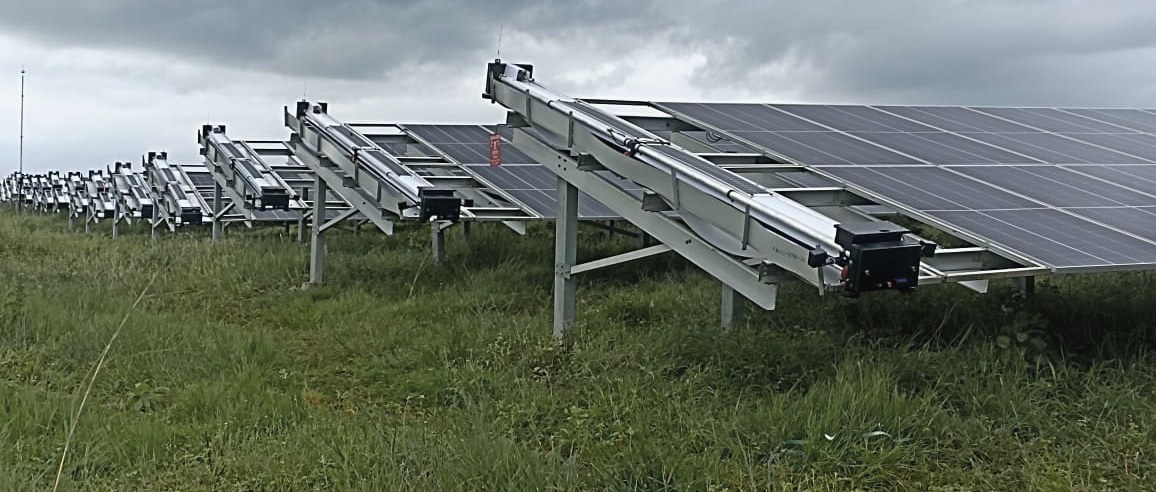
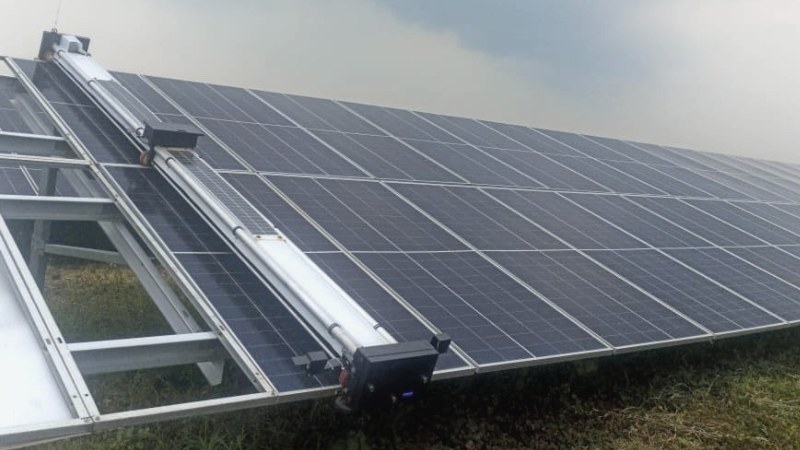
Fixed-tilt cleaning robot
For fixed-tilt ground-mount plants
Runs the full row and parks on its dock. Bridges span the gaps between tables, and a trolley dock carries one robot across several arrays.
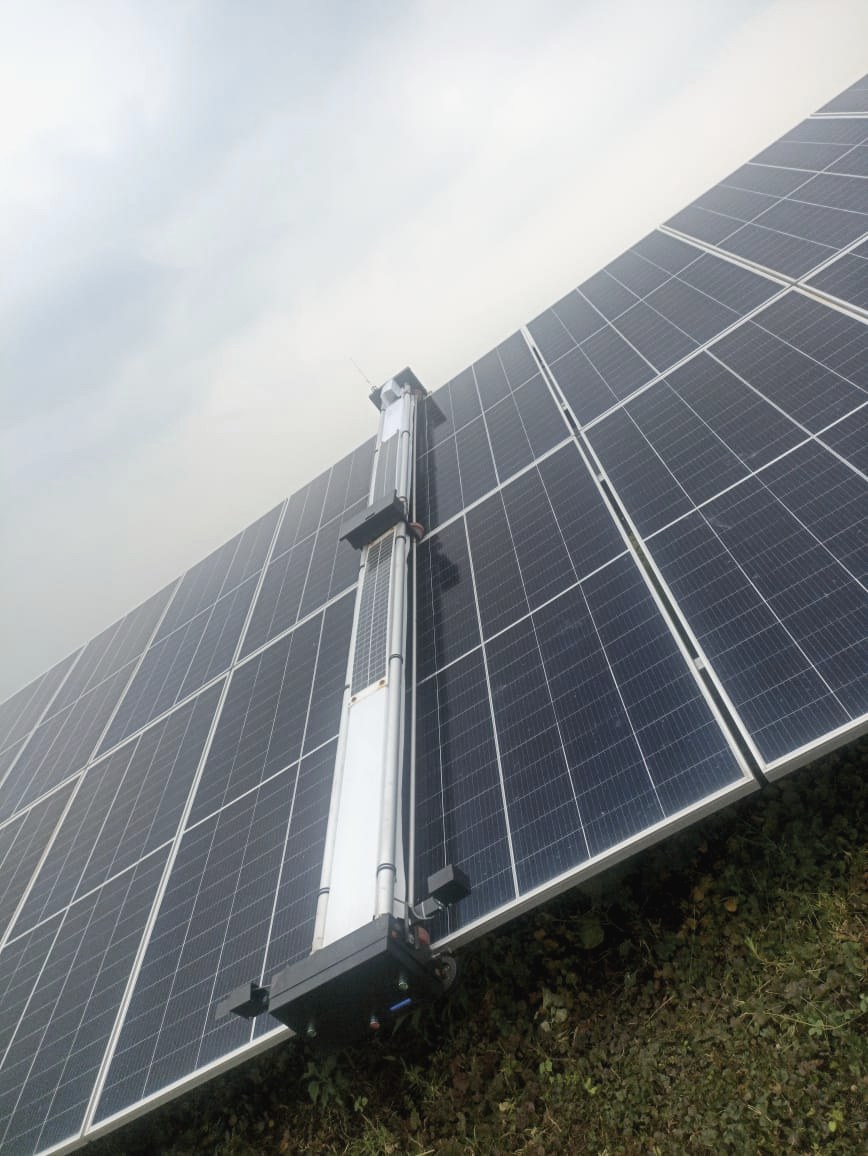
Tracker cleaning robot
For single-axis tracker plants
The same waterless dry-brush cleaning, built for tracker rows.
Full datasheet on request.
The standard machine
- Cleaning speed
- 12–15 m a minute
- Weight
- 45 kg, 2P portrait machine
- Power
- Onboard 120 Wp solar panel, IP65 battery
- Brush
- Six-way spiral brush, PBT filament
- Drive
- Six-wheel drive on PU wheels
- Control
- LoRa and cloud, master–slave
From Vayu’s company profile, October 2026. Figures for the tracker robot are on its datasheet.
Run from one screen
Start a cycle. Watch it. Stop it.
Authorised users start or cancel a cleaning cycle from the Vayu dashboard. It shows each plant’s zones, rows and panels, and where every robot is on its row. Alerts arrive in real time, and the system checks the weather before it runs.
Rows
Illustration of the Vayu dashboard, redrawn for this page with example data. It runs in your browser and controls nothing.
Get in touch
Tell us about your plant.
Send its capacity and location, and tell us the mounting structure. A layout drawing helps.
- Sales
- sales@vayusolar.com
- Head office
- E-39, UPSIDC, Site-B, Surajpur Industrial Area,
Greater Noida, G.B. Nagar,
Uttar Pradesh 201306, India